Sunday, 25 May 2014

Game 18 - First Bull Run, July 1861

The 'Battle Cry' rules, when first published, were a precursor to the now (in)famous Command and Colours and Battlelore rules. Richard Borg's genius here was to find a crossover between hex and chit based wargame and the command / resource management of card driven systems, which emulated the fog of war for horse and musket, and ultimately ancients/medieval/sword & sorcery.

There's no denying that (1) the system is very different in terms of command decisions when compared with 'traditional' wargames rules and (2) it gives a quick game.

With time pressures prevalent for us both in the last weeks, a quick game was the order of the day, but no less demanding and exciting for that.

Ok, so the Battle Cry system is probably not for those who want to see an exact Order of Battle. For us, that was less important here. The big eyeopener though, for at least one of us who has played a lot of Battlelore, was that there is significant mileage to use the precepts and rulings for other periods for a fast set-up, fast play game.

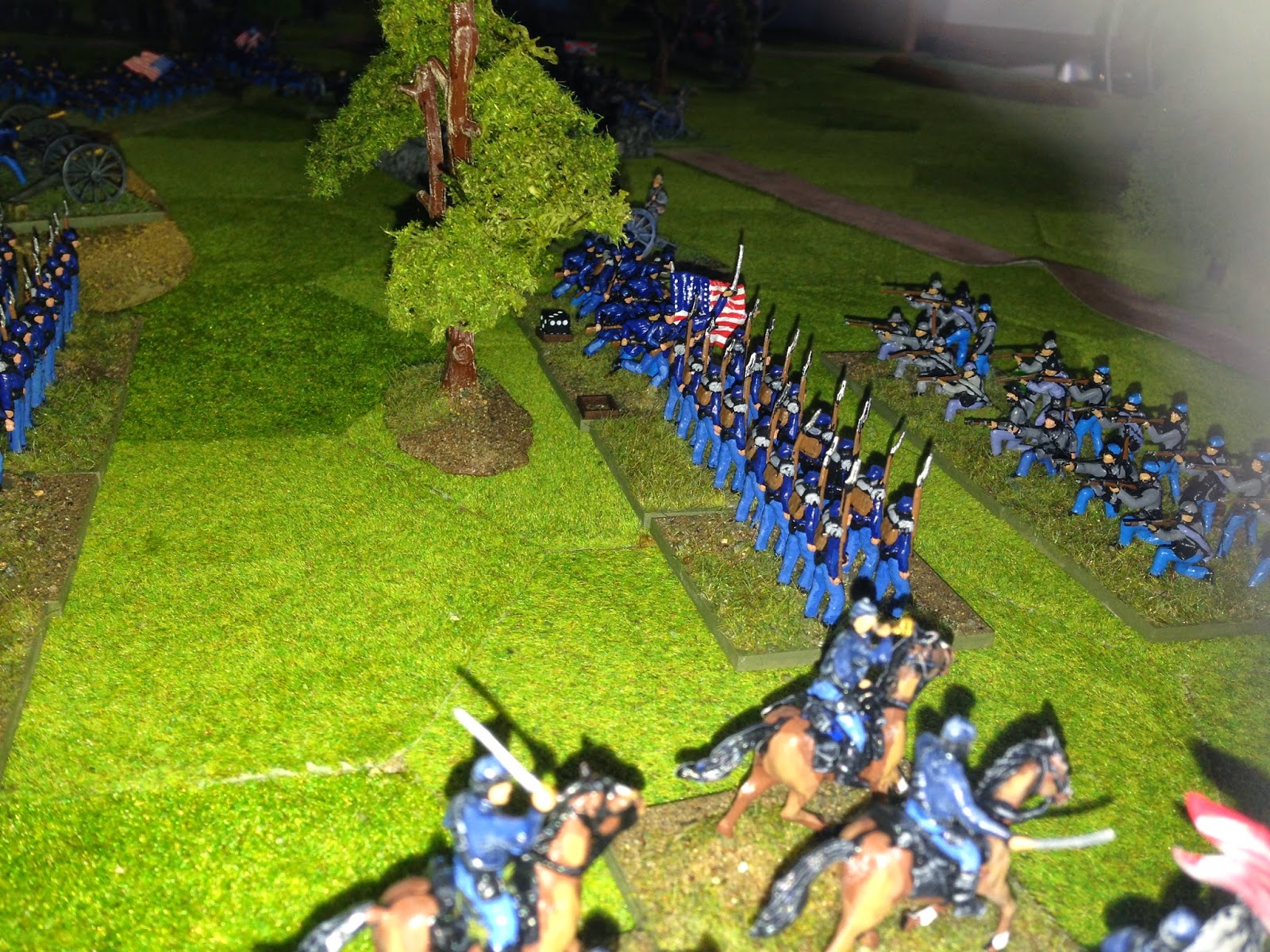
Nicely ordered Union battlelines, which, with the unique card system's ability to focus the player's mind on the flanks for many turns, took a while to get moving.

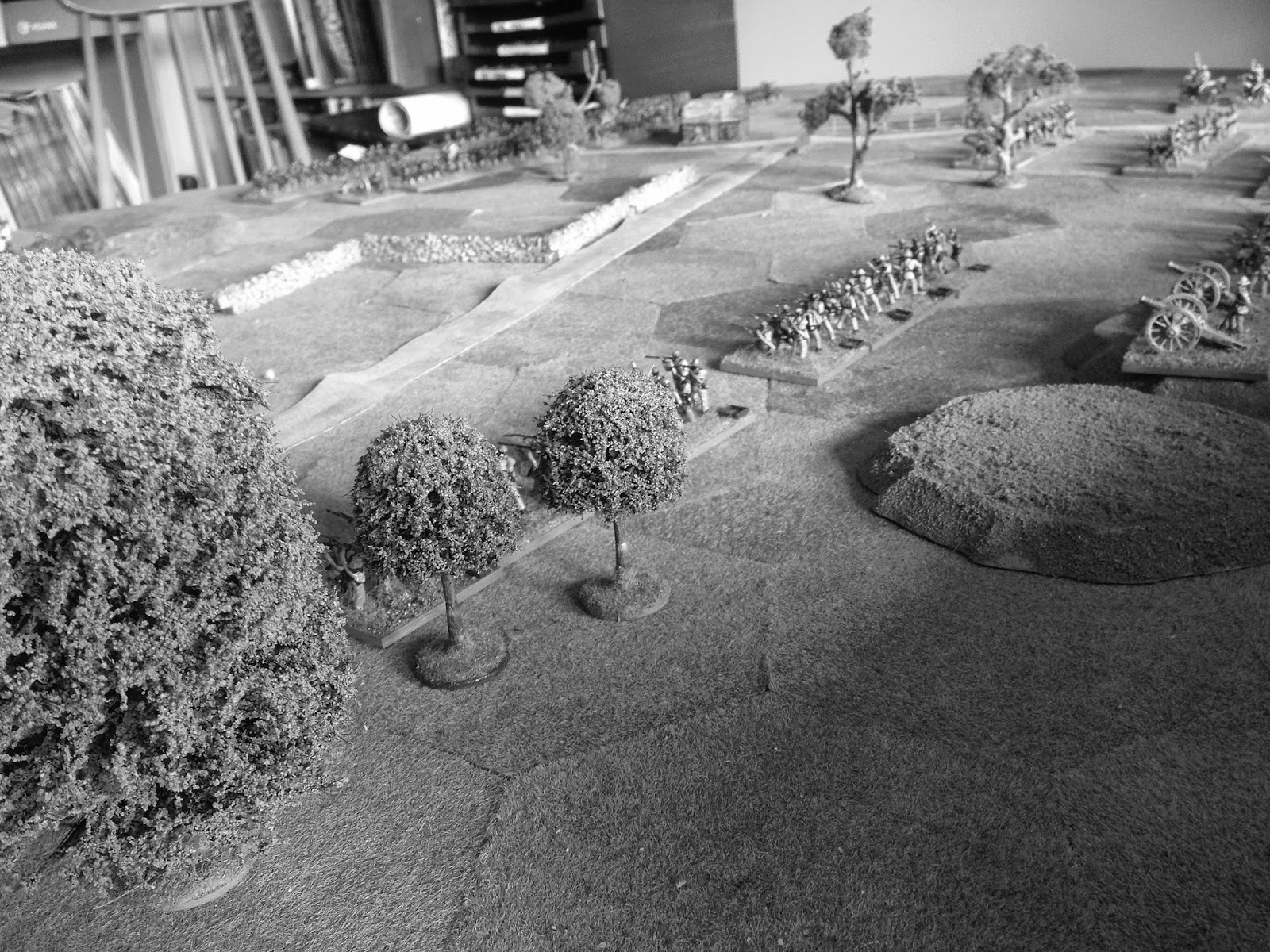
...hiding behind the ridge line, the rebs.


A little cavalry action on the Union right saw significant casualties.


 ...and rebs taking to the woods.

Eventually, the Union centre, taking advantage of Confederate focus on the right and left, begins to move toward the heights.


Effectively pinning the Confederate centre, heavy battles of attrition on the flanks (and a few bad dice rolls) would wear down the rebel infantry.


The ability to 'battle back' is not so prevalent as we see in other versions of the game, but when it happens (card driven in this instance), it can change the face of battle. In this case, Union assaults on the central ridge line are ineffective.

In the end though, gains on the flanks allowed a desperate Union cavalry charge - just enough to destroy the sixth Confederate unit and win the game.


A nicely constructed set of rules for a quick game. Again, as with so many rulesets that we have tried recently, thoughts turn to hacking the rules and card system for other periods. Even seventeenth century Ireland might work here. There are enough event driven twists and turns to make it function as a game perhaps. We shall see...

Sunday, 13 April 2014

Game 17 - Cool Springs Gap...burg (Random ACW Clash)

With little time to set up the next game, we opted to do something quite simple. Neil Thomas had an interesting book out a number of years ago entitled 'Wargaming, An Introduction' (still obtainable on Amazon).


There are some nice rules mechanisms here and some very introductory mechanics. That said, there are a number of areas which aren't covered comprehensively (the rules are simple introductory style after all) and areas such as flanking and arc of fire were swiftly transplanted from other sets as 'house rules' as we played.

 One of Neil's other publications is an Ancient/Medieval variant which will also be looked at here at some stage.

As stated, the set is very much introductory, though most wargamers will add and tinker (even during play) in order to have the mechanisms achieve full effect.


The initial setup pitted a roughly equivalent Confederate vs Uniuon force, though the Union had a slight edge in artillery with the Rebs having a few elite units.


A shot from our roving 1863 photographer as the rebs advance.


Opting for an early assault on the Union centre, the Confederates had some success in driving back the apparently less able Union troops.


 The Union right flank then became important, with elite Reb units trying turn it...though ultimately, in the dense woodland, the chance of a charge succeeding proved hopeless.


 The centre and Union left also become dangerous as regiments began to engage and be forced back in piecemeal fashion.


The arrival of cavalry on the flank, and their subsequent dismounted action helped to secure the Union right.


 As flanks were subject to withering fire from both sides, Union troops were pushed back, while Confederate attacks were held by Union artillery.


 Union pressure however, with mounting numbers, slowly began to turn the flanks as the Rebs ran out of manpower.


Shots of the 'angle' where regiment after regiment was forced back.


With the Union right flank secure, and the left flank unlikely to hold, the game was all but up for the Confederates.


The rules are simple, but do provide a tense game. Rallying can mean that regiments will find full strength again, though this can only happen if they are kept out of range and as morale permits, so as the battle rages, units get weaker and weaker until their effectiveness dwindles. We probably used a few too many units rather than the 8 or so that the author recommends so the game went on a bit. I can see though how similar mechanisms might make an ancients game work well with 8 units a side.

More to come from these elegant rules though I can see a few house rules creeping in.

The book is worth a read if you are looking for something on Amazon and Neil has a Napoleonic book and 19th century version published. I also believe he has a '1 hour wargame' style book coming out.

Sunday, 9 March 2014

Game 16 - The London Derriere

A return to Maurice...because it provides such a tense game.

We didn't have much of a scenario behind this encounter, though we quickly developed a premise where during the siege of Londonderry in 1689, Enniskillen troops had wanted to send a relief force, while at the same time Percy Kirke had landed English troops on Inch Island who had marched unmolested toward the city. Both sides met and consolidated, before facing a fledgling Jacobite force with some guns in prepared positions.

In reality this is a bit of a stretch, as logistics, fear of Jacobite movements and general poor intelligence prevented anything remotely like this actually happening in 1689.

Highlights/Setting Rules:

Jacobite infantry is Poor though cavalry is Elite.
Allied infantry is Trained and Enniskillen cavalry is Elite.
Both forces have hurriedly moved to their respective positions. There are gaps everywhere, and flanks are far from secure.

And of course, it's Ireland in 1689...so it must be raining ;)

Scattered English and Enniskillen forces face the Jacobite lines on the right.


Elite Jacobite cavalry on their left flank.


  Poorer conscript infantry on the right.


 Facing Kirke's 'Lambs'.


 Early moves as Jacobite cavalry flanks advancing Enniskilleners.


  They are countercharged by the allied cavalry. Things move very quickly in Maurice.


 On the allied right, Jacobites are moving, while on the left, a protracted cavalry battle turns into a staring competition for the rest of the game.

 Kirke's English troops have advanced to musket range..which can be decisive depending on training.


The presence of allied cavalry forces a stalemate on the right.

Clashes in the centre.


Allied cavalry charges - some work better than others, but in general they do a lot of damage. Losses in units are rapidly forcing down army morale on both sides however.


By game end (we ran to the night game turn), the Jacobites had one morale point, the allies two. A very close game and a another tribute to the rules. There have been a lot of adverse comments regarding these rules and the system in general, though it really gives a tense game, where the focus is invariably on the points that will turn the battle, while resources are just not available to use for other units. If ever a game reminded one of the ebb and flow effect of real historical battles, based on historical accounts, this is certainly it.

The American Revolution beckons as I think the rules would really fit. There are surprises and reverses galore during play - something which I think we see in the AWI actions.