Sunday, 21 April 2013

Game 10 - Quatre Bras / Ligny

It's not often that both classic 'hundred days' campaign  battles can be fought on a single table, but Snappy Nappy is at such an accessible scale that the transition from how we read about the battle to how we play it, is made more seamless than ever.

BIG benefit to the game is in the almost abstract manner in which manpower is translated into units. As with Volley & Bayonet, the basic unit is the brigade, though V&B takes great pains to represent every single unit (with good reason of course). This can however slow the game down. The principle of Snappy Nappy is that we are interested solely in the corp and its commander. It's his numbers and their relative effectiveness at a point in time that make the difference. Hence, a corps in V&B might have 7 stands/units, while in SN it could be 4 or 5. The scale is 1"=150 yards, so at the reduced scale that I use V&B at (50mm baeses), it should be the same. I used 20mm figures on 50x25 bases - so everything should be equal, but it isn't. SN is a true 'battle' scale. It's the corps and what can be accomplished with them that the commander is concerned with rather than counting strength points. It's effectiveness over numbers.

Advantages:

  • Labelling & breakdown of units is significantly simpler than V&B.
  • The mechanics are breathtaking - troops quality dictates your effectiveness and how easily you pass morale checks (the crux of the game). Hits mean morale checks - and you keep rolling until you pass, with each failure reducing your morale. Good troops (usually) last longer, though I found even the best cavalry units disappearing from the field after bad die rolls at just the wrong time.
I really think this system could be hacked and used elsewhere. ACW really beckons and AWI would be sweet, and truly reflect the difference on the battlefield between British regulars and American Militia (at opposite ends of the spectrum).

Disadvantages:
By the end, we found ourselves not using the orders system. That's a pity, since it is well thought out, and biased toward the French/British (as it should be). It just didn't seem to gel with other mechanics, though it could have been the massive size of the battle we started with  - which left us with too much to grasp in one game perhaps.


And so to the battle:

I cheated slightly. The table I have is 8'x5'. To scale I should have been using 9-10' long, so I squeezed some elements. In the end, it made little difference.

Key things to note:
I sent D'Erlon the wrong way and ended up with him being too late to even get to Quatre Bras - uncannily historical.
Kellerman didn't even go near Quatre Bras. In the end, early hopes of a victory there were completely quashed by not reinforcing it early, due to early indications that it would be a walkover.
Ligny became a flank action and the French were mauled in the centre. Cavalry charges were going off on both flanks like fireworks.
The Prussians suffered but held. The Allies held onto Quatre Bras and wouldn't let go.


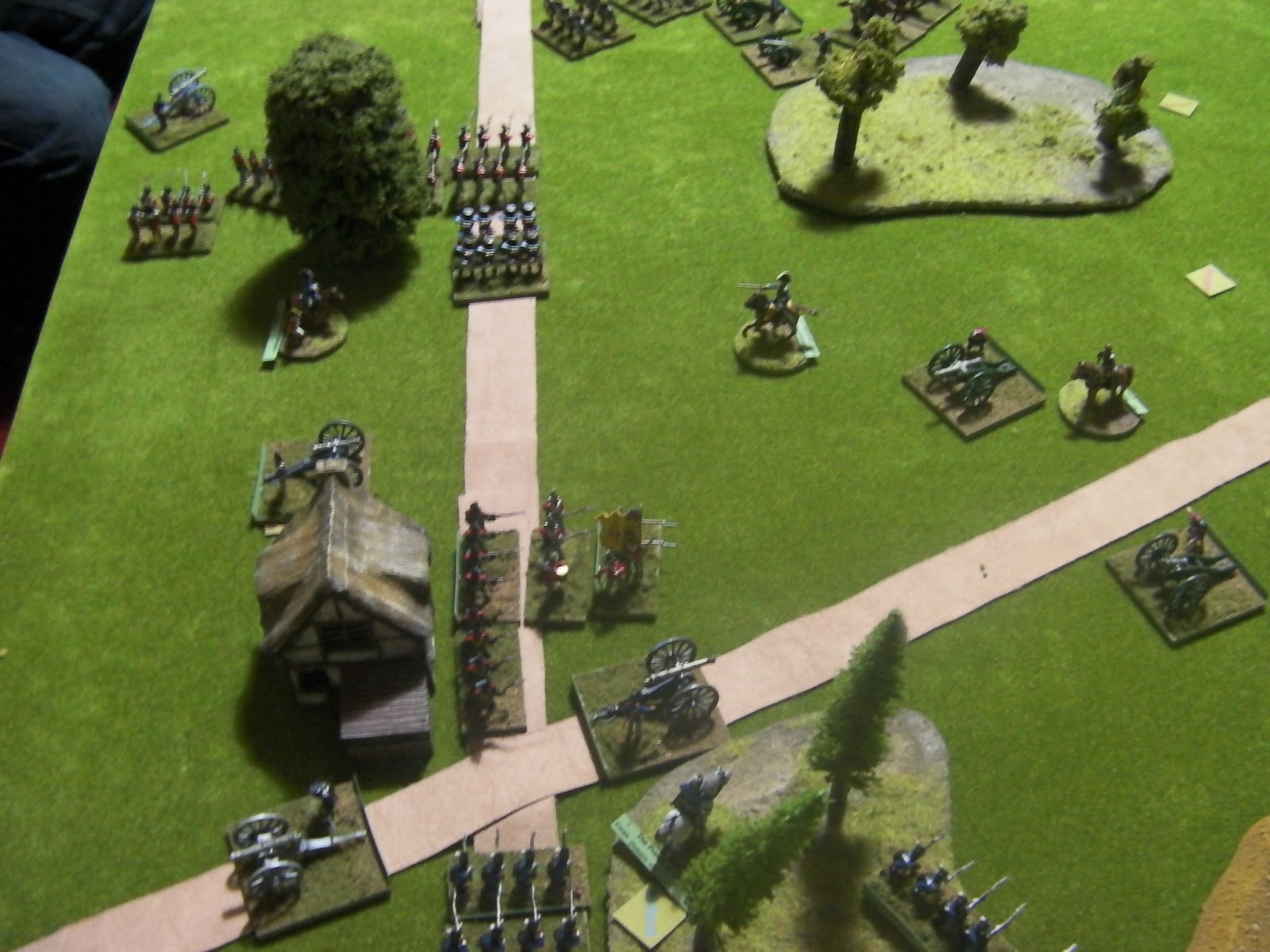
The view from the east, showing Ligny and the Prussian bottleneck (which the French failed to adequately exploit today.)


View from the Prussian lines.


 Vive L'Empereur!!!

The guard stayed in the Namur area until 4pm - a mistake as it turned out.


 View from the Belltower (at Namur ;) )


Prussian Corps on the Allied left - saved the day in the end.


The opening gambit at Quatre Bras seemed desperate for the allies, but there were so many reinforcements still to arrive.

The French hit the Prussian centre early in the afternoon in an attempt to hold their artillery while the flanking actions went off.


Some French breakthroughs in the centre ended up with mauled units, and in the end, two routed corps.


The French right became a hotly contested cavalry action.


While the centre continued to be a meatgrinder.


As Quatre Bras developed, and it seemed that the Allies could be contained and defeated, Kellerman was ordered to the centre!


Allied reinforcements however (and certain very stubborn Brunswickers), would force the French back on their left.


D'Erlon's reinforcements started to arrive and were sent...to the centre, to turn the Prussians' right flank. An unfortunate decision for the French.


(Ahh! So this is where Napoleon keeps his order markers.)


 View on the French right, as cavalry surges against the flank (and neatly manages to balance on the table).


 French attacks became ever more desperate on their left at Quatre Bras.


 By game end, the French were fighting a useless flanking action without taking the main road, while at Quatre Bras, one brigade was left to settle the matter.

A great game with great rules, and those rules certainly demand to be hacked and tinkered with. We'll be returning to them again.


Sunday, 24 March 2013

It's all Steve's fault really...


Steve over at http://steveswargamestuff.blogspot.co.uk/ had recently advocated the uniquely named 'Snappy Nappy' after trying out several rulesets. Being a dyed in the wool Volley and Bayonet convert, I resisted - well for about 48 hours, before ordering the rules based on the good things I was seeing in reviews.


The scale is larger even than V&B, with a two base unit catering for 4000 troops.

This has some unique selling points over V&B for Napoleonic warfare - and removes some of the 'fiddly bits' from a V&B battle of this size, such as skirmishers and division commanders, while still retaining differences between line and column and allowing squares at the brigade level.

The big advantage here however is the 12" to one mile ground scale - the intent being that campaigns over multiple tables or very large battles can be replayed.

Bases are 40x20mm for 15mm figures, which translates neatly to 50x25 for 20mm plastics - roughly equivalent to my 50mm x 50mm V&B bases if doubled up...so rebasing would enable use for both games...

Should I rebase? *sigh*...here it is in progress...


Preparations for the Easter refight of Quatre Bras / Ligny on a single table. It was the scale and the neat mechanisms that got me in the end. The really BIG Napoleonic battles are what this thing is designed for - and both battles together? What's not to love. Battle report to follow.

Sunday, 17 March 2013

Game 9 - Top Malo House, May 31st, 1982

We had used the original Ambush Alley rules a few months back, with a view to getting into the lovely Osprey hardback version of 'Force on Force' (closely based on the older version). Initial impressions re. the rules were that they were all over the place in terms of layout and understanding. I think the grasp we had of the old Ambush Alley concepts certainly helped - especially in terms of interrupts and general reaction concepts.


  Figures were old Matchbox with some Italieri NATO troops for the Royal Marines...

 A few 'Firefight 20' figures from Tabletop Games in the 1980s (I'm dating myself again I feel...)


 The Argentinians were an altogether different matter. These were Italieri (I think) modern NATO Germans/Belgians - painted as Israelis, though representing Argentinian commandos today. I hope that makes it all clear ;) ?


The marine assault force makes its way forward.

The support element moves into an overwatch position on the ridgeline.

Top Malo House, looking uncannily like a Russian Front cottage on this occasion, teeming with Argie commandos.


A dash to the right and the stone wall in order to secure the flank.

 The dash to the outbuildings on the left not so successful, as reaction tests and overwatch take their toll - 3 serious wounds and a shaken unit.

 ...neatly allowing the marines to dash up the flank and secure the outbuildings.

Devastating fire from the marines, and poor defensive fire, as the commandos are pinned and outgunned.

 
This allows the flank fire team to assault the building, effectively outflanking the element at the enclosure and ending the battle. (Although not seen in the pics, a little sniper duel also ended the commandos' day quite rapidly).

Surrender remains the only option today.

A nice game, and gameplay did not suffer from the stoppages that we feared it might. FoF will certainly be revisited, perhaps with a larger Afghan scenario or similar.(Gobin might even win next time!)