Sunday, 17 March 2013

Game 9 - Top Malo House, May 31st, 1982

We had used the original Ambush Alley rules a few months back, with a view to getting into the lovely Osprey hardback version of 'Force on Force' (closely based on the older version). Initial impressions re. the rules were that they were all over the place in terms of layout and understanding. I think the grasp we had of the old Ambush Alley concepts certainly helped - especially in terms of interrupts and general reaction concepts.


  Figures were old Matchbox with some Italieri NATO troops for the Royal Marines...

 A few 'Firefight 20' figures from Tabletop Games in the 1980s (I'm dating myself again I feel...)


 The Argentinians were an altogether different matter. These were Italieri (I think) modern NATO Germans/Belgians - painted as Israelis, though representing Argentinian commandos today. I hope that makes it all clear ;) ?


The marine assault force makes its way forward.

The support element moves into an overwatch position on the ridgeline.

Top Malo House, looking uncannily like a Russian Front cottage on this occasion, teeming with Argie commandos.


A dash to the right and the stone wall in order to secure the flank.

 The dash to the outbuildings on the left not so successful, as reaction tests and overwatch take their toll - 3 serious wounds and a shaken unit.

 ...neatly allowing the marines to dash up the flank and secure the outbuildings.

Devastating fire from the marines, and poor defensive fire, as the commandos are pinned and outgunned.

 
This allows the flank fire team to assault the building, effectively outflanking the element at the enclosure and ending the battle. (Although not seen in the pics, a little sniper duel also ended the commandos' day quite rapidly).

Surrender remains the only option today.

A nice game, and gameplay did not suffer from the stoppages that we feared it might. FoF will certainly be revisited, perhaps with a larger Afghan scenario or similar.(Gobin might even win next time!)


Sunday, 24 February 2013

Game 8 - Quatre Bras - 16th June, 1815

Another foray into Volley & Bayonet. This time a certain little prelude to Waterloo. We used older V&B edition for Marengo, so this time it was full bore V&B ' Road to Glory'. Many nuances and clarifications. As usual with the rules however, they were all intuitive after a few turns.

The scenario was based on that outlined in 'Napoleon Returns' rather than in the recent rulebook (although we plan to do that one in 54mm...you have to love Volley & Bayonet for the refreshing scale adaptability alone).

(Most of the French & Allied figures were Airfix, including some conversions done 30 years ago. Revell British and French too, some Hat and some Newline officers also included.)


The initial setup - the small French force under Foy and Bachelu face a disorganised Dutch Belgian division.


  Initial French reinforcements begin to head to the French left, where hard fighting would be seen throughout the day.


 As the first British/KGL and Hanoverian units began to arrive, the French were committed to the left, in hope of breaking through to the crossroads and the Brussels road.


Light cavalry clashes(!) resulted in a breakthrough charge along the Namur Road, just as Wellington was riding toward his troops.


Picton's reserve was committed on the Allied left early in the day, to secure the road.


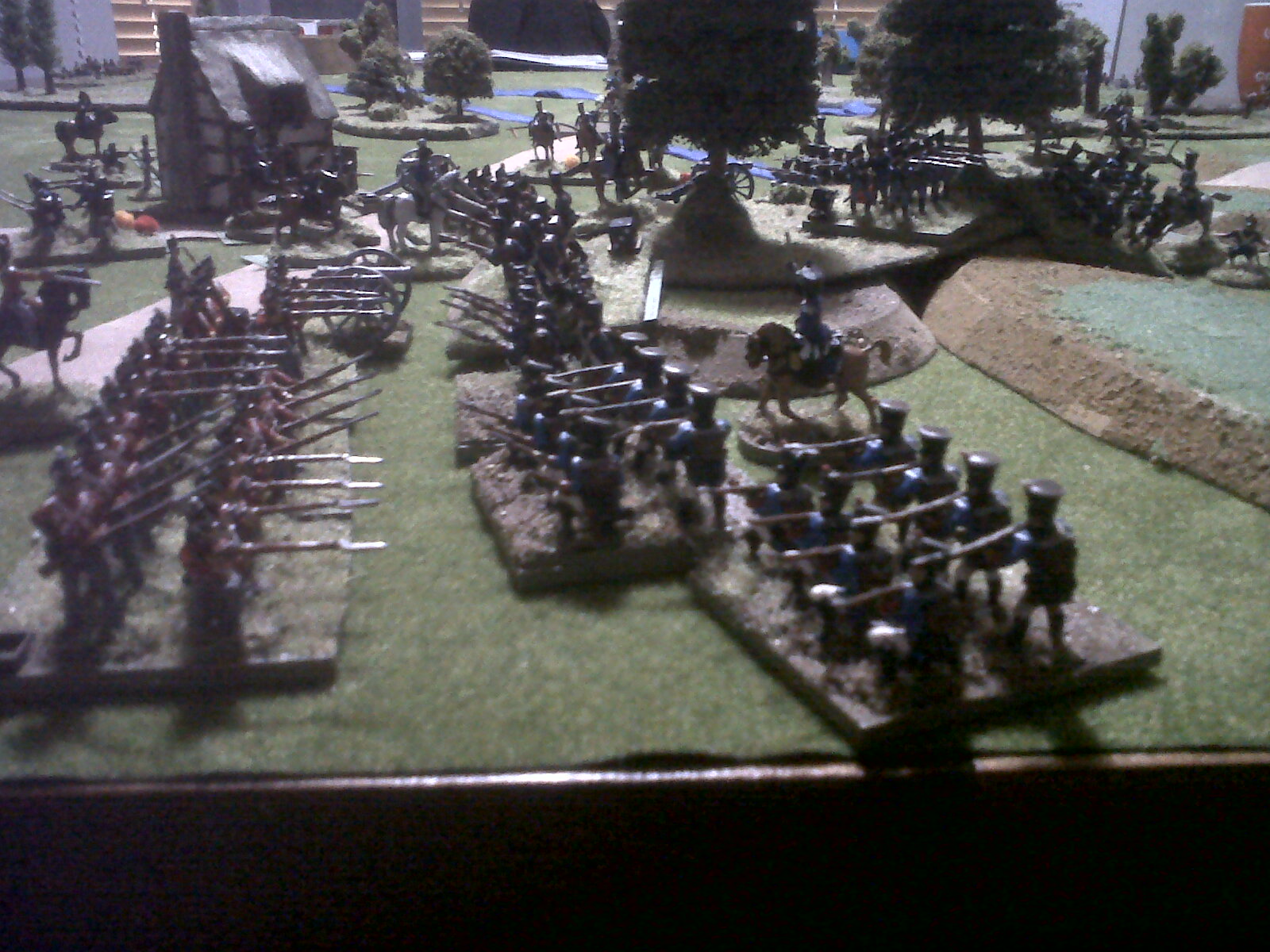
 On the French left, musketry duels begin in earnest. Who would break first? The allied troops had the advantage of shock and sharpshooters - and would most likely win via attrition unless the French did something drastic.
...like moving up their guns...


The centre held, but the Brunswickers and Dutch-Belgians wouldn't stand for long.


 ..and so they broke...


As Picton watched the drama at the crossroads unfold.


  By 6pm Cooke's division had arrived to reinforce the centre...just in time.


While on the Allied left, Kellerman's heavy French cavalry attacked.


 On the Allied right, the French have charged...rather successfully, pushing the line back.


 The situation at the start of the 8pm turn. Wellington, the Prince of Orange and the Duke of Brunswick have rallied the lost brigades to hold the road to Brussels.

Soon after, Dutch Belgian reinforcements arrived and surrounded the French breakthrough at the Nivelles Road.


The Allied left were under increasing pressure from French cavalry, but they were too few and number and it was already too late.


As the French I Corps heads for the crossroads, the allies still hold it...Merde!


A great game once more, with a few nice rule adjustments for the era. As Faulkner Fitzwilliam remarked...'this is true wargaming'.

Next time? Hmmm...more V&B, or perhaps Force on Force or something completely different. Stay tuned.


Oh yes...and the little 'un did the rivers again. though this time of course she had to get paid for it.


Monday, 21 January 2013

Game 7 - Stones River, Dec 31st, 1863

Ahhhh I love the smell of Volley & Bayonet in the morning...smells like, perfection.

The second V&B clash was set during the American Civil War, near Murfreesboro. A little Reb vs Yank, where both historical commanders actually had the same plan - i.e. to turn each other's right flank.

Interestingly, our own clash proved a little different.

But firstly...having decided that my felt interpretations of rivers for the game were far too bland (granted she used a different word. I believe it was 'terrible'), my youngest daughter decided to use her chalks to add a little colour. Now, despite Dad's initial trepidation, she did a fine job, turning the blue felt into fast flowing rivers, as you can see.


The overall effect was really quite impressive. I will have need of these artistic services again...well, at least until she works out that she can charge me money.


...and then Faulkner Fitzwilliam arrived and it became 'Game Faces' time. Choosing the union troops, FF would have the tiresome task of defending his flanks. Now, the neatest mechanism in V&B is centred on division exhaustion levels. This is where troop quality is factored into the division and represents it starting to break as casualties mount. The Union divisions were therefore a little fragile and when to commit the reserve would become an important decision.

The main Confederate attack came on the Union right. Fast moving Reb cavalry charging against the flank. Would Union horsemen hold out?


Astute observors will also note the single (rather than double) dice marker/frame combos used this time - complemented by miniature 'pompoms' (courtesy of aforementioned daughter) in use for disordered and stationary markers.


Meanwhile in the centre, the Rebs mass for a charge. 


While on the right, Gobin begins his planned flanking action with far too few divisions and perhaps a little too late. Of course, no plan survives first contact.


 The left flank sees most of the action as the Union troops bend...break...


...then return valiantly to the fight, stopping the Confederate onslaught. In the background you can just see the reserve committed to the Union right. (Yes, those chaps closest to the camera are running away!..SIR! Look to your Division!!!)


Probably the best decision since not only was the Confederate right mucking about, but the Union left flank had been maneuvered into defensive positions.


Gobin realised at this point that the game was up...as the centre had become a bit of a mess. Charge, countercharge, rout, reform, disorder...dude! Where are my troops?


Volley & Bayonet will return for 'Quatre Bras', when Gobin will have his revenge.

(...and there will be rivers...with chalk on 'em.)