Despite pressure to break from playing Maurice, we have resisted!!! And so, to a somewhat larger battle.
I have fought the Battle of the Boyne in 28mm before, back in 2001 using the Wargames Holiday Centre rules (then printed in a far less glossy Wargames Illustrated). The thought of using Maurice, with the various card management mechanics is quite exciting for a battle on this scale, though that could present a problem when we consider the size and relative flow of the previous battles. To that end, we'll be using some of the regimental options and indeed, notables (Schomberg, Wurtenburg and Berwick, Hamilton etc. who will of course have a foot and cavalry figure to symbolise his daring (or should that be darting) on the day).
This should help spread the load a little in terms of available troops and prevent the local attack and rally 'bottlenecks' halting the rest of the battle. It is critical for instance, that the momentum of the Williamite attack be kept up with ford crossings etc. while the charges of the Jacobite cavalry again and again, be wholly represented in some manner.
As we can see though, there will be some work to do first. My terrain boards have suffered a house move, storage, movement, re-storage and the weight of a world war II book collection in the last twelve years, and so need a bit of work - especially to the river sections. I also seem to have lost the hills and ridges that I had at the time. There is also a large body of newer work which I'll be looking at again prior to the game (Padraig Lenihan's 2003 book for instance - which needs a close re-read).
At the time of the original game, my map was based on Beresford Ellis's The Boyne Water (1976). Although it does suffer a little from its age and absence of certain sources, it still remains a great read and that damned map is forever etched on my brain as I tried to work out scales. My battlefield is the 2x1 mile rectangle marked out on it as I tried to interpret just what I was going to fight. I love this map.
With 4' to 1 mile, or 5280 yards, an infantry battalion at 7.5 inches (5 x 1.5" squares) wide works out at 825 yards wide to scale, which is a little much depending on whether you like 2 paces or 3 between files in a late seventeenth century infantry battalion (see Nosworthy and Graham's work on this) and would mean dropping my 5 base units to 3 or 4 base units. That said, the difference is marginal on a large table and there's plenty of space to get the larger units fighting so it shouldn't affect the rules too much.
I would be keen to go with 3 base units when I do Aughrim (but only because I don't have enough figures HA).
Of course, as with any Boyne refight, we're ignoring James's massive flanking debacle to the west which made things a little easier for William on the day.
So, some scenery touch-up, figures to dust off, hills to find...oh yes, and I have to build Oldbridge again, damn.
Saturday, 14 September 2013
The Boyne - Table Prep
Friday, 30 August 2013
Painting Table Recon...DON'T PANIC!
'Sir, I regret to inform that the content of this damned painting table shows no planning, or desire to get anything finished...it's a bloody shambles Sir!'
'Tis true, I must confess.
With talk of doing a Charlie Company campaign with a larger group of players, the partly painted 'Figures Armour Artillery' Vietnam figures (I think...though there are a few Platoon 20 relics in there too) that I got in the '90s - now no longer available(?) - have pushed their way past troops for the Boyne refight, 15mm 7 Years War French, and even my 25mm AWI British.
If I were a painting factory, I'd probably be as far from 'lean' manufacturing as you can get *sigh*
Keep calm...and carry on...or something like that.
Sunday, 18 August 2013
Game 12 - Crom Castle 1689
This battle is fictional with an OOB developed from (1) the
forces that were (mostly) available in Ireland in 1689 and (2) the Jacobite
strategy that was discussed at the Jacobite Parliament in Dublin in May, with regard to
sending a force to deal with the raids on Jacobite forces and logistics
emanating from Enniskillen. We’ve looked at the actual battle which resulted
from that last time. On this occasion, we’re making a few more assumptions.
The day before the Enniskilleners and Lord Mountcashel’s force
met at Newtownbutler, he had attacked Crom Castle. The original Crom Castle (as
opposed to the current one, built in the 19th century), or at least the
remnant of it, was well defended by Abraham Creighton’s men. This had been the
second siege, as Lord Galmoy had threatened it earlier in the year with his
dragoons/troops. Neither attempt to take the stronghold could be considered a
siege in the classical sense, and on both occasions, Creighton’s troops were
able to fend off any attempt to take the place (though Mountcashel’s effort
with three infantry battalions and cannon was the more serious effort of the two).
Our assumptions for this fictional encounter therefore were:
(1)
Mountcashel was substantially reinforced in the
latter part of July with infantry and dragoons from Sarsfield and Berwick (as
had been promised but never actually happened) and guns and further infantry from
Sutherland.
(2)
Wolseley had not only arrived early from the
ships sent to relieve Londonderry, and rallied the Enniskillen troops, but had
also brought two English regiments and cannon to help garrison the fort.
(3)
Wolseley had left Enniskillen a day or so before
he actually did.
What this all means is that we have two larger forces than
we had at Newtownbutler, and both are well reinforced with Irish/English troops
and cavalry.
The idea behind this of course was to further test out the
Maurice rules in a larger scenario.
All infantry fire was modified for matchlock and presence of
pike elements within the battalion.
All cavalry charges were modified for the presence of pikes
within the infantry block (this made a real difference).
Other points of note for a larger battle:
(1)
The command range can have a really detrimental
effect on your command cards, as you have to spend more and more resource as
your troops disappear into melee, until you move closer.
(2)
Cavalry can sit and stare at each other (perhaps
trading shots and not charging) until it recovers. This all takes time and
removes the focus from other areas of the battlefield. Really excellent for
matching the period (Sarsfield at Aughrim for instance).
(3)
Musketry is random and deadly and can break a
regiment well before its time if the troops are poorly disciplined.
(4)
You can get pinned on a flank, worn down, while
the opponent pulls a surprise move elsewhere on the battlefield, but you are
left with no resource in terms of cards and may have to ‘pass’ to get more,
letting your opponent retain the initiative. We found that this
initiative/momentum changed several times throughout the game. Excellent stuff and very reminiscent of the journals and historical records.
The remains of the original Crom Castle today - sixteen miles from Enniskillen and part of a large estate.
And so to battle:
The defender's setup. Having opted to position troops outside the castle, Wolseley has positioned his artillery (what there was of it) in fixed positions within the castle. Guns didn't move too much once deployed in the late seventeenth century.
A cavalry clash on the Jacobite right as they send their elite cavalry and (not so elite) dragoons into the fray, hoping to turn a flank and exploit it. The Enniskillener horse suffers badly and is routed through receiving too many disruptions. The English regiments on the flank are forced to wheel and defend the integrity of the whole position. Activity was centred here for several turns.
With a new flank formed, and Enniskilleners moving from the centre to reinforce it, the infantry on the Jacobite right begins its attack. The action was important here for several more turns, with both commanders focused on the outcome, leaving cavalry and infantry on the flanks, staring at each other without command. The Jacobites had failed to exploit their flank action, though it would have meant charging straight into the English regiments, who were well trained to repel them.
Mountcashel's regiment and a guards regiment lead the assault on the covered position outside the castle. Musketry takes its toll, but the Jacobite decision to charge home proves fatal. (Maurice is very unforgiving in this regard, as it should be.)
The situation on the attacker's right remains quiet, though additional infantry are moving through the woods toward the English flank.
A cavalry action on the left, with charge after charge, is unresolved until the end of the game.
The right too could still be fought over, though there are too many other issues with the attack for Lord Mountcashel to focus here.
A breakthrough of sorts, as an Enniskillener regiment routs.
But the attacker's momentum in the centre could not hold, and the attack is stalled, with only a single Enniskillener regiment left defending the line. A final assault on the Jacobite right also proved fatal, as massed English pikes broke the dragoons and the cavalry was decimated.
We ended the game at that point. Though army morale on both sides was low, the Jacobites simply had no more infantry left with which to occupy the position.
A great set of rules, with a result within 2-3 hours.
Monday, 12 August 2013
Game 11 - Newtownbutler 1689
I admit, it's been a while since the last game, but the Maurice rules have made it worth the wait.
Some immediate observations though:
1. The game makes nice use of card activation and events which can mean that (really) unforeseen events pop out of nowhere. For a quasi fictional wargame campaign, this is wonderful, and probably lends itself to tales of the 'best laid plans' rarely panning out. When trying to refight a historical battle, it's a distinctly double edged sword, where events can be uncannily accurate while others can have little place on the actual battlefield. That's not a criticism of the rules though, which are very free flowing.
2. I used the adjustment for pikes listed in the rules, which makes musketry a bit less useful, cavalry a
little more brittle and charges a lot more effective if they come off, though of course melee is very risky. Makes for a great game though.
3. Newtownbutler had very little room for maneuver as a narrow raised 'causeway' and marshy ground (which allowed infantry to pass but not cavalry) characterised the approach. This meant that the approach and immediate battlefield was 'somewhat 'squeezed', thus leaving the Enniskillener commander with many headaches.
4. Following that - the rules lend themselves to flanking and maneuver though are heavily restrictive on what the active player can do in a turn. If you like being able to do everything with all your troops, prepare to be disappointed. This is a real military resource management system, which to me makes perfect sense when we consider many of the historical sources.
5. I was really concerned that there weren't enough units to do the rules justice. Yes, I can see how more units would create a larger command headache, but I still got a real feel for how the system works. Larger 9YW or AWI battles would be real epics, especially where very different troop qualities are thrown into the mix. I'm not sure how one would retain the drama in multi player games, though there are guidelines for it.
6. Some of the cards allow real player vs player interaction, where the bonuses used by one player for charging are wiped out by a defensive card, or the hope of firing first is disrupted by the enemy firing first because of a card play. Makes for exciting and very unpredictable games. Of course, any true old schooler who wants to busy himself counting up modifiers and having a sore head may not like this. I won't ever desert the simplicity of Volley & Bayonet though this is a different type of game.
The rough OOBs from last time were used. In the actual battle, Wolseley's Enniskillers encountered the swampy bogland (which was impassable to cavalry), the only access for horses being the narrow causeway toward the high ground. This was defended with Mountcashel's cannon. The Enniskillen troops charged across the bog with infantry - toward the high ground where Mountcashel had assembled his troops. Mountcashel's men got off a few vollies, though could not slow the charge.
When the Enniskilleners reached the guns at the base of the hill, they quickly disabled them, allowing their cavalry to charge in column along the causeway. Melee on the hill and close range vollies ensued, with the Jacobite troops coming off worst. First, their dragoons (who had been bloodied earlier at the Lisnaskea skirmish) broke, then the infantry (mostly conscripts) began to falter. With the advance of the Enniskillener cavalry, the Jacobies routed, leaving only Mountcashel's troops to fight a losing battle. The rest fled into the surrounding bogland, though very few escaped with their lives.
The Enniskillen accounts (Hamilton and McCarmick) also describe the detachment of the pike elements from each battalion, so that they would not slow down the matchlock elements during the charge across the bogland. I tried to mimic this in the game. There was no real effect on frontages in terms of mechanics and the Maurice rules do grant bonuses to those with and without pikes during the early part of the game's period, so, a nice touch.
Mountcashel himself was captured and taken to Ennikillen, though would escape later in the year and get to Dublin, where he would be enlisted by the French to lead the Irish regiments in the French army in mainland Europe, until his death in 1694. Wolseley would go on to fight with the Enniskilleners at both the Boyne and Aughrim, before his death in 1697.
And so to battle:
In comparison with earlier games, the battlefield was certainly a little sparse. Enniskillen troops, having been ambushed outside Newtown(butler), have passed through the town and are making for the Jacobite position on the hill at Sandholes. (In reality, there is a large ridge between town and hill, but it makes little difference in game terms).

The requirement for cards can take up a little space on the table. 25mm in use today, although with 15mm figures and a 6'x4', these would be quite unobtrusive. Having said that, the cards are almost a game in themselves and a welcome addition to the table. I've placed a few in the pics that follow. That's purely for effect as they don't need to be left amidst the figures.

The Enniskillen troops start to close on the Jacobite position...


...straight into the sights of King James's artillery detachment.

The first cards start to appear, affecting hit chances and general mechanics. 'Well laid guns' increase the chance to hit,

while 'find the way' allows the Enniskillen infantry to move across the bog without incurring disruptions (uncannily accurate),

...while 'that's not on the map' makes one area of it impassable - HA! (Granted, for a historical refight, this makes it less historical, but this is what makes campaign games unpredictable).

As the Enniskilleners charge the guns (which had little effect), they are slowed on their left flank, and encounter a fresh battalion.

...or perhaps not so fresh, as it breaks when charged (bad dice rolls) and the Jacobites are forced to commit their dragoons/cavalry to their left flank. (This reduces army morale based on a dice roll. The commander needs to keep a close eye on this as the entire army can fracture and run).
More cards help with charges and melee. The cards tend to focus the commander's attention. There may be a grand plan, though it's destined to change as the situation remains fluid. The Enniskilleners charge over the guns in the centre toward Mountcashel's own battalion, with their cavalry behind them on the causeway.

Repeated vollies in the centre, and the threat of Clare's regiment outflanking them, force the Enniskillen troops to shift position (they have a lot of disruptions and rallying attempts would slow the momentum). They are replaced with a cavalry charge.

Finally, the Enniskillen left flank is moving, though the Jacobite centre is solid.

Some nice cardplay allowed the Jacobite player to move an Enniskillen battalion in line for a cavalry charge, just as it was about to hit the rear of Clare's battalion. Total chaos! HA!
Another example of card/counter-card play, as one bonus to stop the charge is outweighed by another which gives it a bonus.
Finally, in the centre, after mounting pressure from Enniskillen cavalry with the Jacobite cavalry failing to engage in force, Mountcashel's regiment breaks. It's enough to reduce their army morale to breaking point, and the army withdraws.
Maurice is unpredictable, exciting and gives a great game. There is little old school feel to it, though that of course is a good thing in certain instances. Having scanned the campaign rules and the notables/characters involved, a campaign would write itself and remain fluid and entertaining. I will look at these again with a 1690 Irish campaign in mind. Very nice indeed.
Some immediate observations though:
1. The game makes nice use of card activation and events which can mean that (really) unforeseen events pop out of nowhere. For a quasi fictional wargame campaign, this is wonderful, and probably lends itself to tales of the 'best laid plans' rarely panning out. When trying to refight a historical battle, it's a distinctly double edged sword, where events can be uncannily accurate while others can have little place on the actual battlefield. That's not a criticism of the rules though, which are very free flowing.
2. I used the adjustment for pikes listed in the rules, which makes musketry a bit less useful, cavalry a
little more brittle and charges a lot more effective if they come off, though of course melee is very risky. Makes for a great game though.
3. Newtownbutler had very little room for maneuver as a narrow raised 'causeway' and marshy ground (which allowed infantry to pass but not cavalry) characterised the approach. This meant that the approach and immediate battlefield was 'somewhat 'squeezed', thus leaving the Enniskillener commander with many headaches.
4. Following that - the rules lend themselves to flanking and maneuver though are heavily restrictive on what the active player can do in a turn. If you like being able to do everything with all your troops, prepare to be disappointed. This is a real military resource management system, which to me makes perfect sense when we consider many of the historical sources.
5. I was really concerned that there weren't enough units to do the rules justice. Yes, I can see how more units would create a larger command headache, but I still got a real feel for how the system works. Larger 9YW or AWI battles would be real epics, especially where very different troop qualities are thrown into the mix. I'm not sure how one would retain the drama in multi player games, though there are guidelines for it.
6. Some of the cards allow real player vs player interaction, where the bonuses used by one player for charging are wiped out by a defensive card, or the hope of firing first is disrupted by the enemy firing first because of a card play. Makes for exciting and very unpredictable games. Of course, any true old schooler who wants to busy himself counting up modifiers and having a sore head may not like this. I won't ever desert the simplicity of Volley & Bayonet though this is a different type of game.
The rough OOBs from last time were used. In the actual battle, Wolseley's Enniskillers encountered the swampy bogland (which was impassable to cavalry), the only access for horses being the narrow causeway toward the high ground. This was defended with Mountcashel's cannon. The Enniskillen troops charged across the bog with infantry - toward the high ground where Mountcashel had assembled his troops. Mountcashel's men got off a few vollies, though could not slow the charge.
When the Enniskilleners reached the guns at the base of the hill, they quickly disabled them, allowing their cavalry to charge in column along the causeway. Melee on the hill and close range vollies ensued, with the Jacobite troops coming off worst. First, their dragoons (who had been bloodied earlier at the Lisnaskea skirmish) broke, then the infantry (mostly conscripts) began to falter. With the advance of the Enniskillener cavalry, the Jacobies routed, leaving only Mountcashel's troops to fight a losing battle. The rest fled into the surrounding bogland, though very few escaped with their lives.
The Enniskillen accounts (Hamilton and McCarmick) also describe the detachment of the pike elements from each battalion, so that they would not slow down the matchlock elements during the charge across the bogland. I tried to mimic this in the game. There was no real effect on frontages in terms of mechanics and the Maurice rules do grant bonuses to those with and without pikes during the early part of the game's period, so, a nice touch.
Mountcashel himself was captured and taken to Ennikillen, though would escape later in the year and get to Dublin, where he would be enlisted by the French to lead the Irish regiments in the French army in mainland Europe, until his death in 1694. Wolseley would go on to fight with the Enniskilleners at both the Boyne and Aughrim, before his death in 1697.
And so to battle:
In comparison with earlier games, the battlefield was certainly a little sparse. Enniskillen troops, having been ambushed outside Newtown(butler), have passed through the town and are making for the Jacobite position on the hill at Sandholes. (In reality, there is a large ridge between town and hill, but it makes little difference in game terms).
The requirement for cards can take up a little space on the table. 25mm in use today, although with 15mm figures and a 6'x4', these would be quite unobtrusive. Having said that, the cards are almost a game in themselves and a welcome addition to the table. I've placed a few in the pics that follow. That's purely for effect as they don't need to be left amidst the figures.
The Enniskillen troops start to close on the Jacobite position...
...straight into the sights of King James's artillery detachment.
The first cards start to appear, affecting hit chances and general mechanics. 'Well laid guns' increase the chance to hit,
while 'find the way' allows the Enniskillen infantry to move across the bog without incurring disruptions (uncannily accurate),
...while 'that's not on the map' makes one area of it impassable - HA! (Granted, for a historical refight, this makes it less historical, but this is what makes campaign games unpredictable).
As the Enniskilleners charge the guns (which had little effect), they are slowed on their left flank, and encounter a fresh battalion.
...or perhaps not so fresh, as it breaks when charged (bad dice rolls) and the Jacobites are forced to commit their dragoons/cavalry to their left flank. (This reduces army morale based on a dice roll. The commander needs to keep a close eye on this as the entire army can fracture and run).
More cards help with charges and melee. The cards tend to focus the commander's attention. There may be a grand plan, though it's destined to change as the situation remains fluid. The Enniskilleners charge over the guns in the centre toward Mountcashel's own battalion, with their cavalry behind them on the causeway.
Repeated vollies in the centre, and the threat of Clare's regiment outflanking them, force the Enniskillen troops to shift position (they have a lot of disruptions and rallying attempts would slow the momentum). They are replaced with a cavalry charge.
Finally, the Enniskillen left flank is moving, though the Jacobite centre is solid.
Some nice cardplay allowed the Jacobite player to move an Enniskillen battalion in line for a cavalry charge, just as it was about to hit the rear of Clare's battalion. Total chaos! HA!
Another example of card/counter-card play, as one bonus to stop the charge is outweighed by another which gives it a bonus.
Maurice is unpredictable, exciting and gives a great game. There is little old school feel to it, though that of course is a good thing in certain instances. Having scanned the campaign rules and the notables/characters involved, a campaign would write itself and remain fluid and entertaining. I will look at these again with a 1690 Irish campaign in mind. Very nice indeed.
Saturday, 13 July 2013
Newtownbutler 1689 - Orders of Battle
Using the research and OOBs from the books mentioned in the previous post, I've constructed two forces for the game:
Lord Mountcashel's Jacobite Troops
Justin MacCarthy, the newly made Lord Mountcashel, was a very experienced soldier having served in England before the Popish Plot, France with the Irish regiments there and even Denmark. He had been given the task of ending the threat from the Enniskillen garrison, which had spent time gathering forces since Tyrconnel's purges and who had been, through their raiding actions, providing problems for Jacobite logistics while most of the fledgling Irish army was engaged at the siege of Londonderry.
The grander strategy that had been discussed at the May 1689 Dublin Parliament, had involved using Berwick and Patrick Sarsfield's troops in conjunction with Mountcashel's movement from the south. Sarsfield and Berwick had both fought smaller Enniskillener detachments in the previous months. Berwick had even achieved a victory of sorts at Cornegrade Castle. There would be no link up of the three armies however, and Mountcashel would be forced to fight alone.
There are varying historical records with regard to numbers, so we'll just field the regiments present for 'Maurice' with more detail when we try out other rulesets.
Mountcashel's Regiment
Mountcashel's own troops. Detailed in the Jacobite Narrative and the works of French ambasssador D'Avaux and Former Lord Lt. Ormonde, this would have had between 450 and 600 men. Of all the regiments, it would have been the best led, best trained and possibly the most experienced - therefore regular. Greater numbers are suggested in other sources.
Bophin's Regiment
John Burke's (Lord Bophin's) had 13 companies though records suggest that it was undermanned. There is some historical discussion of conscript troops being added to the muster as Mountcashel moved north. Classed as Poor or Inexperienced troops.
Clare's regiment
Daniel O'Brien's (Lord Clare's) infantry regim,ent. Again classed as Poor - though Major Marigny, a French envoy, was present here. Again inexperienced.
Cotter's Dragoons
Recorded as having around 360 men. These would have been classed as regular.
Clare's Dragoons
Recorded as having had 450 men. At least part of the force of dragoons was mauled at the Lisnaskea ambush earlier in the day with Anthony Hamilton. One regiment will be classed as Poor therefore.
Artillery
D'Avaux records 4 artillery pieces -classed as small field pieces, though sources suggest less. We'll use one gun model here - regular.
The Enniskillen Garrison
Led (literally for days) by William Wolseley, who arrived with Kirke's Londonderry relief force, the Enniskillen garriosn had been raiding and fighting for months and can be classed as a mix of regular and a few elites.
Col. Tiffin's Battalion of Foot
5-6 companies
Wynne's Dragoons
2 troops
Wolseley's Foot (main body)
9-11 companies
Berry's Horse
8 troops of cavalry
(Berry had conducted the earlier ambush at Lisnaskea where Anthony Hamilton had been caught napping)
Major Stone's Horse
8 troops of cavalry
More on the battlefield and prep next time. One unusual facet of the Enniskillen sources is that the Enniskillen regiments leave their pike element 'behind' when they move over swampy ground on foot. This is understandable since the ground in question was impassable to cavalry on the day. More on this, and how we will simulate it, next time. (We might even get the game in LOL).
Saturday, 29 June 2013
Newtownbutler 1689 – ‘Prep’
I’ve been looking at Newtownbutler in 1689 as the first
battle with 'Maurice' rules. Late seventeeth century (nine years war) has to be one of
my favourite periods despite its relative unpopularity in terms of ‘in vogue’ wargaming. The Irish
battles in particular are very interesting, so expect the Boyne and Aughrim to
follow. We’ll also be looking at these in terms of ‘Black Powder’ and of course
‘Beneath the Lily Banners’ by the League of Augsberg gents.
Many would argue that the Boyne or even Augrhim was the real
turning point of the Irish war in 1690 and 91 respectively. However, prior to
the battle at Newtownbutler in July 1689, the Protestant descendents of the
original plantation settlers had seen the army purged and restyled by
Tyrconnel, in a Jacobite mould, apparently with the blessing of James II (on
the throne since 1685 and determined to improve the lot of his Catholic
subjects).
With a protracted siege at Londonderry, with most of the
Jacobite army tied up in the north, the town of Enniskillen would be a base for
raids, skirmishes and a general thorn in the side of the disorganised but large
Jacobite army.
The Jacobites themselves had few capable generals, but
amongst those they did have were Justin MacCarthy (recently made Lord
Mountcashel) and Anthony Hamilton (brother to Richard Hamilton who commanded at
the siege). Both had fought in France. MacCarthy especially was a gifted leader.
Under orders to end the Enniskillen threat once and for all,
Mountcashel with a force of 4,000 (or so - see the books below) would meet the Enniskilleners (Commanded by
William Wolseley – newly arrived by ship with Percy Kirke to help relieve
Derry) at Newtownbutler – sixteen miles from Enniskillen.
In essence, the battle was little more than a large skirmish
in the scheme of things and when compared with later battles. Before the battle
however, the Enniskilleners were nothing more than raiders. After it, they
would be seen as a force to be reckoned with and Lord Mountcashel would be
captured and held in Enniskillen (at least until his later escape). One could argue that this relatively small affair, when seen in context with the siege at Londonderry, was the turning point in terms of the height of Jacobite power in Ireland.
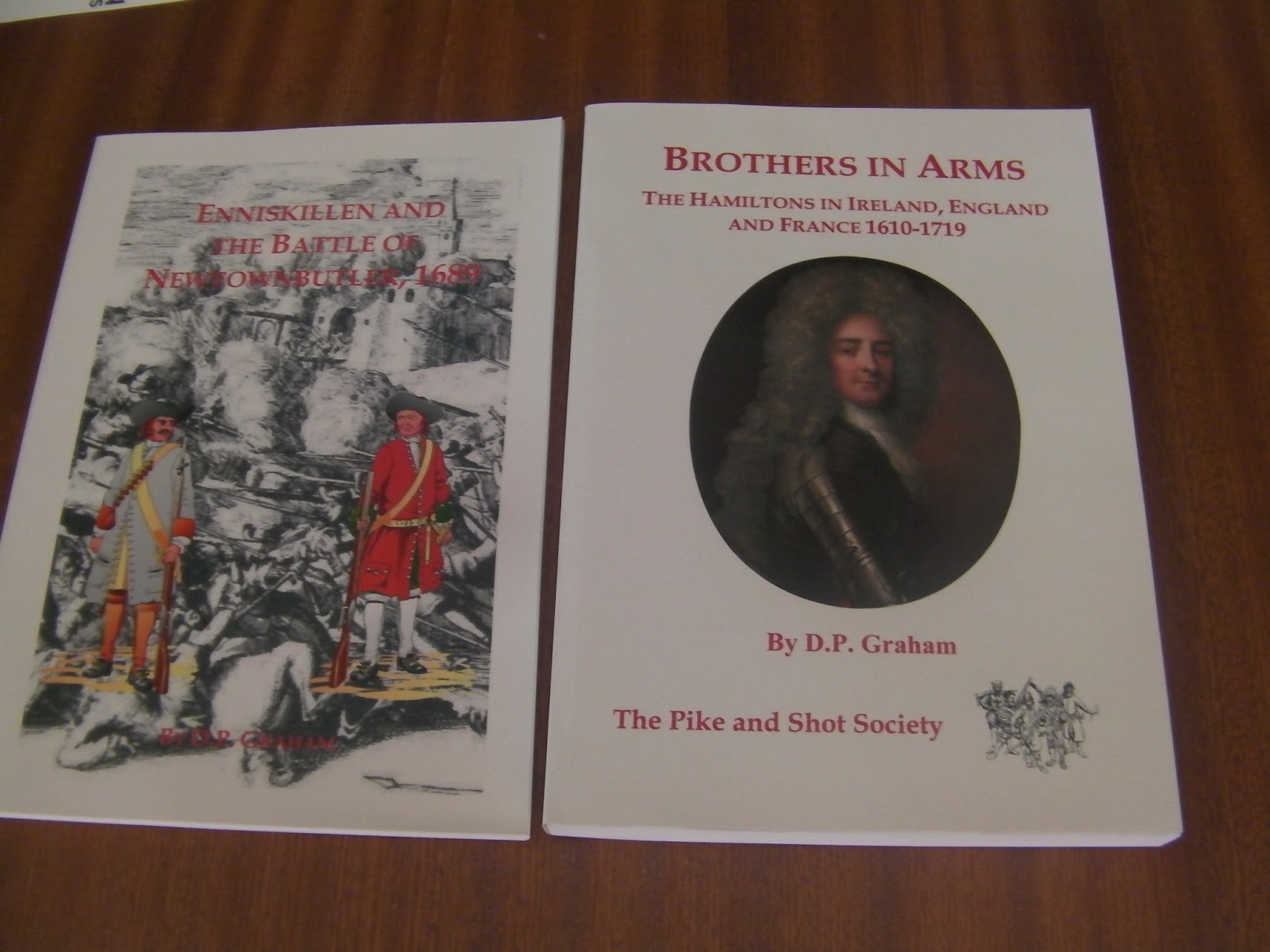
The buildup, battle and aftermath can be found in these two
excellent books by Graham.
Some very good research here.
Some leadership elements shown in pic. These were originally
supposed to be William IV, The Duke of Berwick (James Fitzjames – bastard son
of James II and the only man to have defeated the Enniskilleners in open battle
(skirmish!) at that time at Cornegrade Castle) and Schomberg. These were being
done for a Boyne game – but they’ll substitute for Mountcashel and Wolseley for
the Newtownbutler scenario.
(Evening shadows or crap photo - can't decide which. Warhammer style toadstools courtesy of 'da bruvaz' - you know who you are... I'm not sure whether such toadstools grew in Ireland in 1689, but they look nice. Yes, yes - the historical accuracy button-counters will be on my case now, I know.)
Hoping to get this game done soon. OOB to follow.
Subscribe to:
Posts (Atom)