Saturday, 23 April 2016

Le Duc on the Road - Part deux - Athlone Castle

So this one came about a few weeks ago as I had to take my eldest daughter to an athletics meet in Athlone.

Remembering my late 1600s history of Ireland (and in between events), I of course remembered a certain siege. The castle is still there (alright, there has been a bit of rebuilding since the heavy bombardment during the second siege!) and a fantastic Nine Years War section with videos, uniforms and interactives. It was refurbished in 2012 with the new museum part added.

Originally a wooden structure, and existing through the medieval period, the castle gained notoriety during the sieges that occurred during the Williamite wars in 1690 and 1691.

Colonel Grace's refusal to surrender to General Douglas, a desperate bridge battle (Donnybrook - I'm looking at you for re-enactment rules) and a massive bombardment during the second siege are all notable events. There is plenty of fodder here for suitable scenarios.

View from the west, before crossing the bridge.

Proceeding up the entry-way - reputedly built well after the siege with sections of rubble to provide the foundations.


Some great full size art pieces - great period flavour. Grace's refusal to surrender...


Williamite artillery train.


Video interactives showing the history of the second siege (I had the place to myself).


 Great maps and artwork - showing the progression of the fight.


 The fight at the bridge - Ginkel's engineers and the defenders. Crying out for a Donnybrook scenario.


 Period uniforms for the senior officers - stylised in artsy fashion.

Col. Richard Grace

Gustavus Hamilton


 Wurtemburg

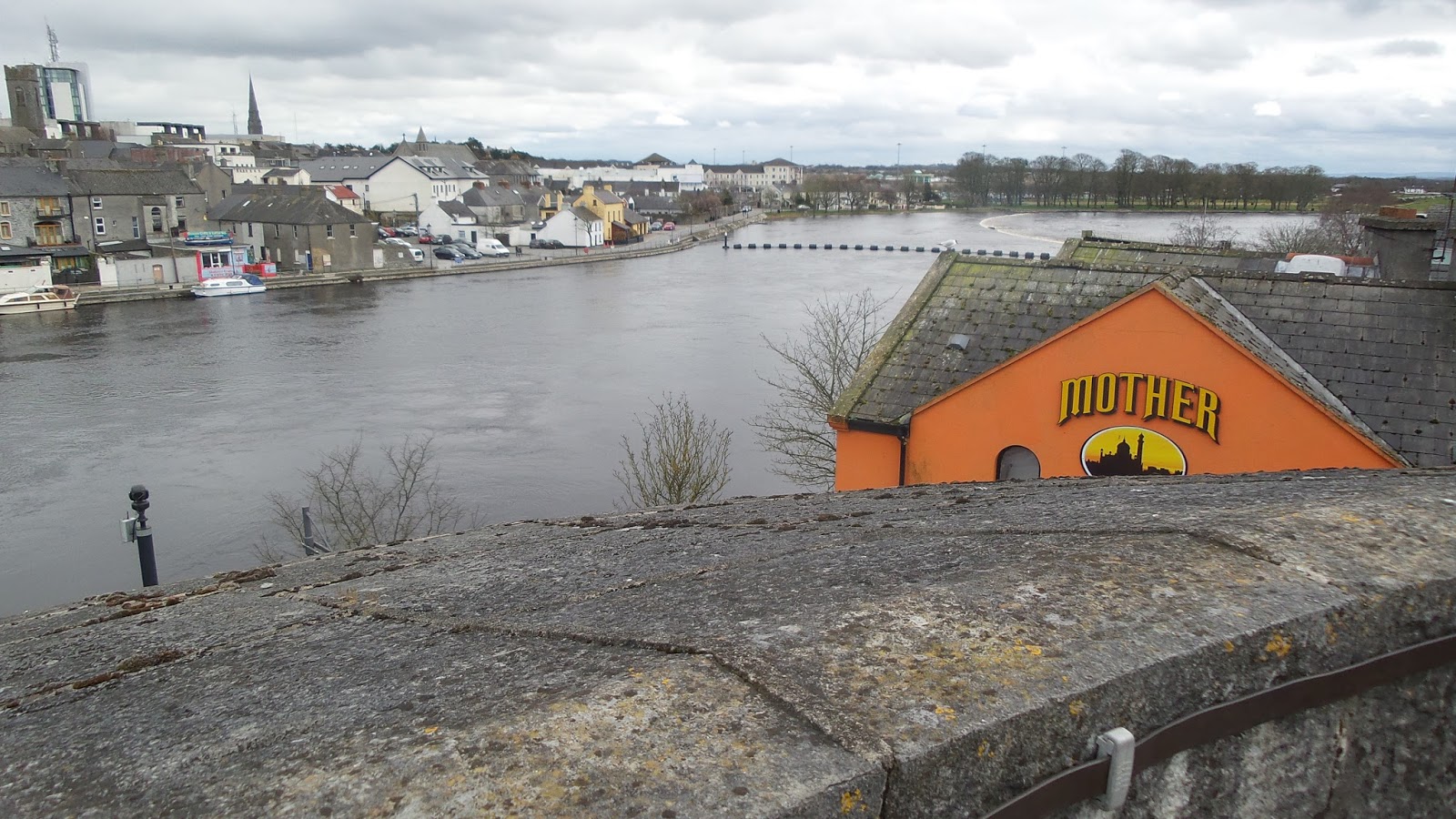
 View back into town across the bridge - looking east.


 View toward the ford of the river - very approximately where Ginkel's troops would have crossed to end the second siege (there would not have been an Indian Restaurant there at that time ...ahem).


There was a lightning strike in 1697 which blew up the (then) magazine and further destroyed the walls. They've taken precautions now - clearly - the heaviest lightning conductor I've ever seen !


 The 'keep' and museum area.
View from the outside walls.

Would certainly recommend a visit if you're in Ireland. A great slice of late C17th history too.


Sunday, 10 April 2016

Game 40 - One Hour Wargames - AWI Clash - 'Late Arrivals' Scenario

So finally, we've tried The 'One Hour Wargames' rules/scenarios by Neil Thomas. A lot of attention and discussion with Steve over at Sound Officers' Call on this one.

So the main thrust of the rules is small playing space, six or so units, and minimal rules are the order of the day - and you are dicing for damage when in range, each unit has 15 'hit points' etc.


That said, there are some real subtleties and of course the nature of the rules lend themselves to being hacked:

  • With the C18th version, only cavalry can charge. We amended that to state that British infantry could charge, and that militia would flee, but continentals would not etc. The tendency then is to wear down those 15 HPs with musketry and go in with the bayonet. That said, go too early, you bounce off and face a hail of musketballs. There's a delicate balance between knowing when to charge, and gambling what you will get with d6+2 damage. (We changed the rules a bit for AWI cavalry - and will probably change more).

  • There were elements where we found ourselves saying - 'this is really simple', though then discussing whether that meant a lesser game. The answer is a definite 'no' here.We agreed on various questions and moved on. It was like 1974 or something!! Would we have obtained a more enjoyable result with Black Powder or similar, and a better narrative? I don't think so.

  • A key feature is that moving units don't fire in the turn. This developed into a realistic alternate 'grind and exploit' game as units traded volleys while other units moved up. I haven't seen this 'period' flavour in many other rules 'designed in' so succinctly. There are some subtleties here.

  • We allowed some cover bonuses for fences etc. stating that militia would only endure more than one round if 'parked' behind a fence.

  • The benefit here is speed. Battles take an hour or so (duhh!) but the benefit of that is campaign play. If you had a campaign on hexes with multiple units, the battles could be fought out as units/task forces engage, then onto the next encounter and mop up the mess  - with the strategic situation developing very quickly.
  • The d6 damage mechanic gives a lot of variability (we killed a guards unit with musket and cannon), though whether accidentally or not, that adds a little chaos to the battlefield. Still thinking about this one, but the d6 has never been so powerful! 
  •  Just by chance, we used a yellow / red / black dice combo to outline the hits taken by unit (red at 7 points +, black at 13 points+ etc.) - which gave us the idea of generating certain issues for units when they hit the black dice (after 12 points of damage) - perhaps preventing further charges, or stopping units moving forward etc.

The other BIG benefit I could see was the hit point system:
(1) They aren't just hits. In a campaign or operational game, they could represent supply and logistics.
(2) As Steve does on Sound Officers' Call, there is probably a need for officers/leaders being able to rally once per game to restore hit points. We also allowed the guards unit to self rally once per game - denoting it from the regulars in this manner.

Actually - perhaps leaders can move units in their radius - but if attached to a particular unit, then the others in their 'brigade' can't move unless elite...

Other changes could be +/-1 for really poor or elite units, but these are minor amendments.

We didn't exactly use the 3'x3' suggested either, though did allow American reinforcements to enter on turns 5 and 10 as per scenario, which actually helped their victory considerably...oops


'Hold the line boys!" Militia in their most useful position; placing muskets on the fence line.


British light infantry moves through the woods. The only units that can here.


As British infantry moves to secure the right flank.


 'Wait 'til you see the whites of their eyes boys!' (oops, wrong battle)


 First American reinforcements. Get that damned cannon in position quickly!

 Pressure mounts on the militia...

 ...as British cavalry threatens the flank. There just aren't enough American units to hold...yet.

 Finally...


 A fresh British unit positions itself to charge the fence line.

The centre sees British pressure too, but this unit takes very heavy damage from the artillery and musketry (lost count of how many sixes were rolled here :)) )

 Bye guys...time to go.

About time. American reinforcements enter at the road...

 ...with a second unit appearing on the flank, just in time.

Withering fire from American muskets and cannon on the guards.


By game end, units were hitting their hit point totals and disappearing rapidly.

A great game in about 60 minutes. Really good stuff, and lots to think about here.


Saturday, 2 April 2016

Le Duc on the road - Part 1 - Carrickfergus Castle


Not much gaming in recent weeks, though I have been out on the road a bit, so here’s some (relevant…no really) pics from recent visits.
Carrickfergus Castle is one of the last remaining (if not pre-eminent) Norman castles in the UK and Northern Ireland. It has a long history from the days of Norman expansion, and was originally constructed (well the keep and a bit more after a motte & bailey concept) by John de Coucry in 1177, as a base when he conquered the rest of Ulster. He built it on a rocky 'crag' - and the area became 'crag-fergus' or 'castle of crag', now Carrickfergus.

It sits on a strategic position on the northern arm of Belfast Lough, and has been besieged in turn by the Scots, Irish, English and French over the years.
It was besieged by Schomberg in 1689 when held by Jacobites, is the landing point of William III in Ireland in 1690, and was attacked by Thurot’s French in 1760 in a little known seven years war escapade.
Oh yes…and in 1778, John Paul Jones of AWI fame lured a RN ship from its moorings nearby on Belfast Lough, before winning an hour long sea battle.
Later, the castle was used as a garrison in WWI and a magazine/armoury in WWII (the secret tunnels and stores areas still exist - stretching out well into the lough).
 There is also a Churchill tank and a 25 pounder not far from the castle (see pics below). The Churchill (an earlier version - perhaps named after Churchill himself or his 17th century ancestor Marlborough-John Churchill, in line with the historical designation of the Cromwell etc.?) was originally conceived and prototyped by Harland & Wolff in Belfast (which still exists...just, after decades of shipbuilding, to provide  heavy fabrication & wind farm structures), and there was some local manufacture afterwards.

My father actually remembers an area of H&W called the 'tank shop' right into the 1960s - yet he could never work out why, so I'm surmising that the prototypes were built there before being transferred to Vauxhall.

Bronze statue of William III, who landed near the castle in 1690.


 View looking east along the coastline from the battlements. If you squint, you can see a tank and a 25 pounder.

 View south toward the opposite arm of Belfast Lough - Bangor direction.

View of the town, looking to the north-west.

Clearly some Frenchie has stolen the business end of his Brown Bess.

 
 ...and his mate is pointing his firelock in entirely the wrong direction...unless the buggers have got in already...

 Classic 1970s horror film view of the 'The Keep'

A nice replica of the castle during the 1689 siege, with some lovely 54mm minis inside.

 So they explain the different painting schemes away through outlining how the Jacobite defenders were a bit of a 'motley' crew in terms of uniformity. I think either (1) the painter got bored and wanted to change his/her colour scheme or (2) there were originally supposed to be a lot more figures...and the painter got bored or (3) the budget ran out.


 Nice sketches of period uniform though.

 
 King John on the pot. Apparently the only authentically medieval crapper in the castle.

 The great hall at the top of the keep. This work was done in the last 20-30 years, as this area used to house arms and armour from across the years.


 ...and these stairs used to allow access to the top of the keep, until the Health & Safety guys said 'nope'.

 D&D anyone?

 It's a trap!

1970s horror...part 2.

Yep. I thought her bum would be a bit cold sitting there too.


 Cuthbert the crossbowman. No really, that's what it said on the bloomin' sign.

 ...and in case you couldn't see the Churchill earlier...

Looking west. The castle in all its glory.

 Close up of the 25 pounder at 'Marine Gardens'.
 And the Churchill. It really is in very good condition, and as with many WWII tanks I've seen, contains hatches which most blokes of today would find increasingly hard to get out of.  (ah, the perils of chocolate and fast food).