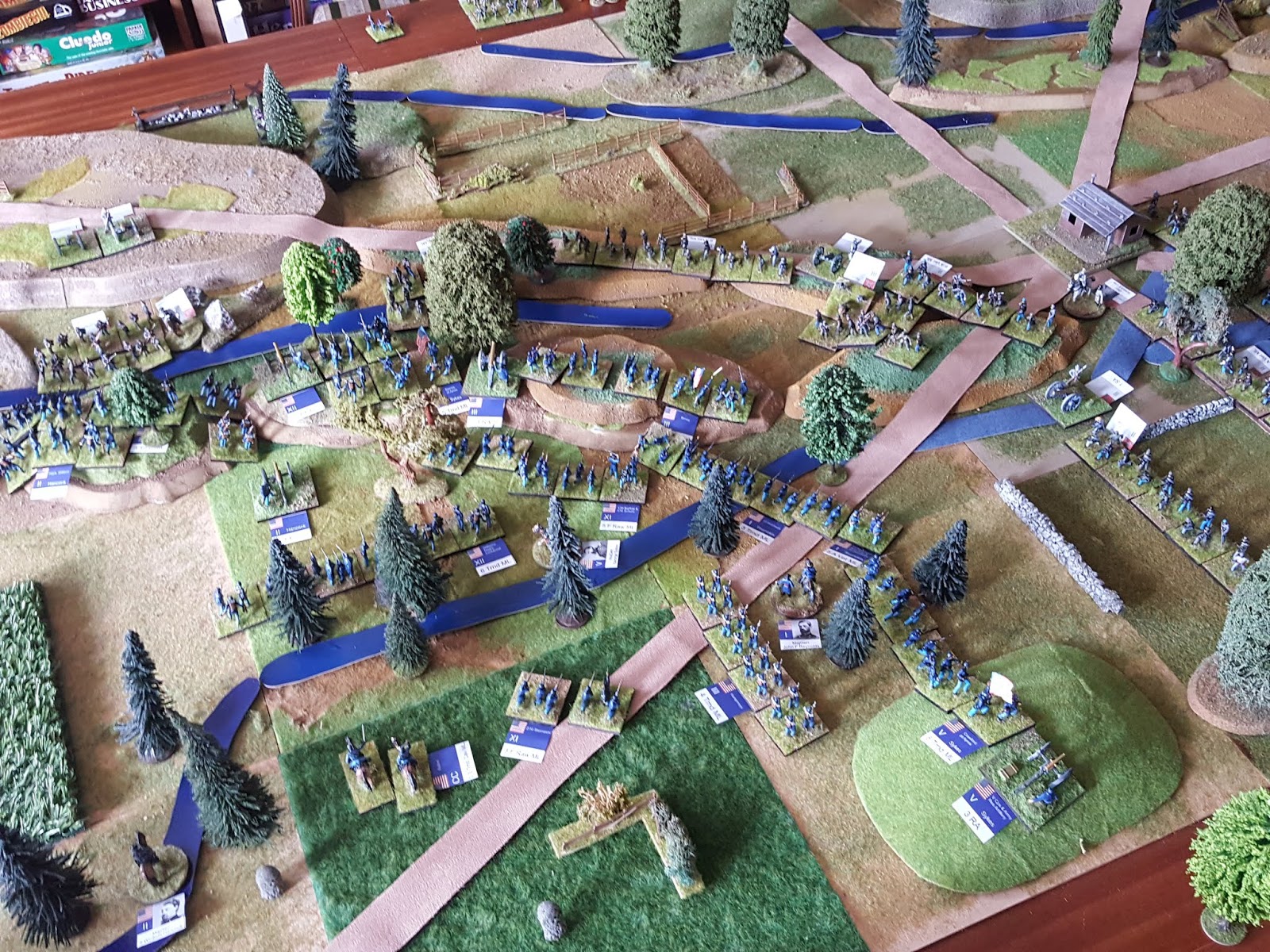
This game actually started out as a trial for the 3rd edition
Warfare in the Age of Reason, which I picked up recently, though after set-up, and the realisation that despite the wonderfully traditional turn sequence, the chain-of-activation was based on a random card draw, we decided to abandon all hopes of trawling through rules that would boil down to a card draw to activate a random unit, and play the scenario with
Maurice instead!
So, the set-up is based on the Battle of Speyerbach as featured in the
WitAoR rule-book, but as I couldn't be bothered learning the rules, we regressed (read - 'advanced') back to
Maurice.
Takeaways for this superlative rule-set include:
- The Lethal Vollies national characteristic is either too lethal, either that or I seem to 'luck out' with the English each time we play hehehe; though I can see how, if used sparingly, it can be representative of platoon fire and British troops during AWI battles.
- A la Baionette N.C. is adequately foiled by the Steady Lads N.C., even if the French get their charges in early.
- Every time we play this set, the battlefield gets split!
 |
| Some nice classic Minifigs. |
- This game is about not having enough resource to do what you want! Period! Show me another set that does it as well. Granted, we see it in C&C but perhaps with a little more randomness. Only Field of Battle seems to grant the same degree of battlefield chaos.
- By learning how to manipulate these rules, you inevitably learn how to fight on the C18th battlefield, because the design is so good - there, I said it!
Standard setup, little terrain.
This is where it gets weird, yet logical. French cavalry move on their right, foiled by a 'that's not on the map' card, that planks terrain in the way of the French charge, yet this slows things down really, as the French irregular cavalry (we're experimenting with how to classify dragoons) can get through. Predictably, this did foil the French flanking plan - which had repercussions later.
In response, the allies make cavalry moves on their right, which never quite amount to anything, whilst holding the French left in check throughout the battle. This is what I mean by forcing you to think in C18th terms. You simply can't do everything, but you can make the enemy think through non-engaging, 'classy' maneuvre.
The French centre maneuvers to adapt to the threat on their left, which started via their attack on the right.
As musketry kicks in, the cards are flying.
Historically, we have been very bad at positioning commanders during their part of the turn. We now realise how critical it is, unless you want to waste away your best cards. The commander needs to be where the action is hottest so that he can use crappy cards to make a difference.
French still have high hopes of breaking the thin red line, (ok so it's a little early for that).
...but not with firing rolls like this...
Breakthrough? ...or will French hopes be focused on other areas of the battlefield for the balance of the game? (It's a rhetorical question...)
The French can shoot well too, mind you.
French/Irish mercenaries charge into the flank of Allied cavalry - but this splits the battlefield, and removes the focus from the French assault on the centre.
...allowing Allied units to snake round the flank and pour deadly vollies into the French, whose charge had been pushed back.
Some nice classic MiniFigs and Dixon French.
It's all gone to hell in the centre.
The Allied right - where it's a stalemate; neither side wanting to risk a charge, as morale is wearing down.
'I'm all over the place here,...'
They think it's all over...
...it is now! Victory snatched from the proverbial jaws of being
trounced...
A great game. Each time we play this, there are more nuances and subtleties in the rules. You have to watch army morale, whilst pooling resources and pushing in the right place. It's a beautiful design, and each game seems to reveal a little more of the nuance of the game design.